
A Busy Life Demanding Clear Vision
Last summer, we met Kristo Elias—filmmaker, researcher, and former free spirit—just after his Flow3 procedure. Despite juggling multiple projects and preparing for a trip to Ethiopia, he made time for a quick chat with us. We caught up at Tallinn University, a short walk from both KSA Silmakeskus and the ERR building, before his evening lecture.
What keeps you so busy, Kristo?
"Quite a lot, honestly. I produce several TV projects—I host 'Osoon' on ETV every week and record reports for Vikerraadio's 'Ekokoob' programme. Both send me across Estonia and abroad regularly. Beyond that, I host events, and right now we're preparing a new season of 'Ajujahi,' which I present. I'm also studying media communications and journalism at Tallinn University, aiming to defend my master's thesis this spring. The summer gave me a little breathing room, and a major life event—I got married—definitely recharged my batteries."
From Arctic Expeditions to Studio Work
You filmed in the Arctic last spring under extreme conditions. What drew you there?
"The Terskei Mountains archipelago—we call it the 'Gateway to the Arctic'—inspired us after following explorer and researcher Timo Palo's famous 2012 expedition from the North Pole to the Terskei range alongside Norwegian Audun Tholfsen. We wanted to experience the Arctic's frozen beauty firsthand. The mountains are ideal for climate change research, so we documented stories with Estonian scientists working there, but we also explored what the Arctic and its landscapes offered us. There are no trees, and at first glance it seems empty—but there's so much to see and experience. We travelled by dogsled and snowmobile, discovered glaciers and caves, and summited peaks.
We had exclusive access to a seed vault built inside a mountain and the Terskei satellite station. We encountered musk oxen and arctic foxes. There was constant polar bear risk, so we carried rifles. It was an invaluable experience to share with viewers."
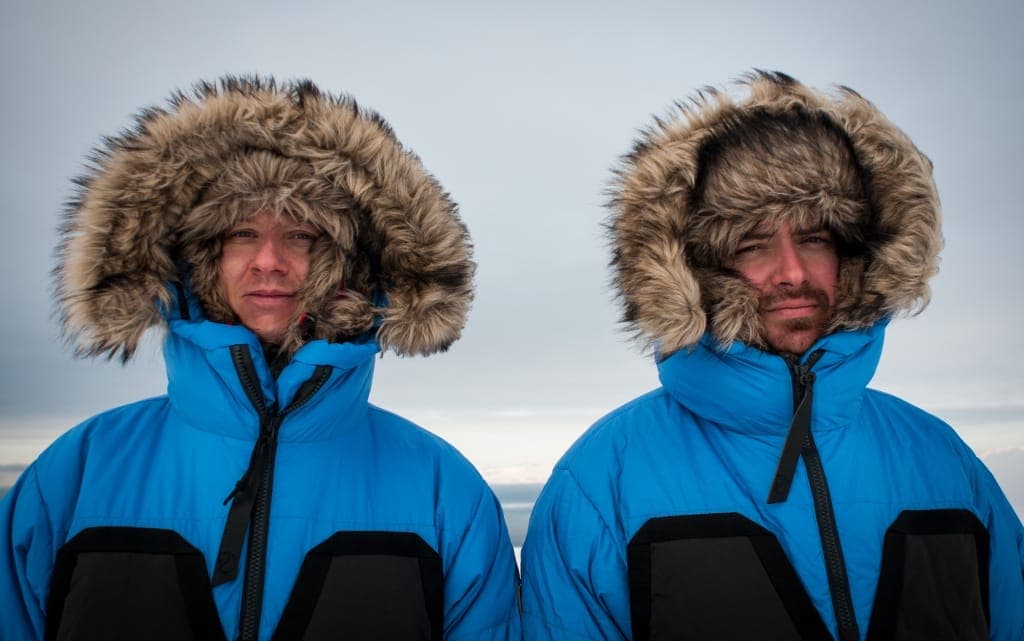
Director Mihkel Ulk and Kristo Elias. Photo: Madis Reimund.
The Contact Lens Problem in Extreme Conditions
You were filming in the Arctic in spring, still wearing glasses and contacts. How comfortable was that in those freezing conditions?
"Filming for television means long workdays and constant pressure. Inevitably, this strains your eyes and dries out contact lenses. By evening, my eyes were completely exhausted. Contact lenses in Arctic conditions?
Almost impossible—the cold, wind, and dust make them uncomfortable within minutes. I was constantly adjusting them, which broke my focus on the work. Glasses fogged up instantly when moving between the cold outside and warm shelters. It was frustrating and genuinely affected my productivity.
I'd worn glasses since childhood. For years, I assumed that was just my life. But the older I got, the more I realised how much my vision correction was limiting me—especially in demanding work environments like Arctic expeditions or live TV presenting."
Why Flow3 Was the Right Choice
What made you consider laser eye surgery?
"Honestly? I started asking around. Friends recommended KSA, and I was impressed by their reputation. What really convinced me was learning that the clinic's own staff had chosen Flow3 for their own eyes. When the people performing the procedure trust it enough to have it done themselves, that says everything. No marketing campaign is more powerful than that.
I chose Flow3 specifically because it's flapless—no cutting the cornea, which felt safer, especially for someone as active as I am. The recovery time was also realistic for my schedule. One week off work seemed manageable; two months wouldn't have been."
And the results?
"Life-changing. Genuinely. The first morning I woke up and could see clearly without reaching for glasses—that was surreal. No more dry eyes by evening.
No more fogging. No more fidgeting with contacts in the field. When I returned to the Arctic for follow-up filming, I could actually focus on the work instead of managing my vision.
I've since used my eyes in ways I couldn't before. I can film in harsh weather, travel without worrying about supplies, swim without removing lenses. It sounds small, but it's freedom I didn't realise I was missing."
Back to Work—and Beyond
How quickly did you return to your normal routine?
"The recovery was faster than I expected. Within a week, I was back on set. Within two weeks, I was doing everything normally. The only instruction was to avoid intense physical exertion briefly, which wasn't a problem for desk and studio work. Dr. Ants Haavel and his team were incredibly clear about expectations, which made the whole process feel controlled and safe.
Now, I can't imagine going back. Every project is easier. Every trip is simpler. Whether I'm presenting live, filming documentaries, or sitting through university lectures, my vision just works."
Any advice for others considering it?
"Do your research. Ask questions. Visit the clinic and meet the team—that matters more than you'd think. And if you're active, travel frequently, or simply tired of managing contact lenses and glasses, don't wait. Life is too short to see it through lenses you have to constantly adjust."
Ready to See Clearly?
Kristo's story isn't unique. Since 1999, KSA Silmakeskus has performed over 55,000 vision correction procedures. Our clinical team chose Flow3 for their own eyes—the ultimate proof of confidence in the procedure.
Want to know if Flow3 or ICB lens replacement is right for you? Take our quick vision assessment or book a consultation with Dr. Ants Haavel and his team in Tallinn. Your clear vision might be just one week away.
© 2026 KSA Vision Clinic. All rights reserved.


